And Surgeons
Advocacy Proposals Being Considered for 2026

Medicaid Reform in Virginia
By Bruce Silverman, MD
I am writing to respectfully request that you and the Coastal Virginia Medical Society endorse legislation to transition Virginia’s Medicaid program from private Managed Care Organizations (MCOs) to a state-administered Managed Fee-for-Service (MFFS) model—an evidence-based reform shown to dramatically reduce costs, improve health outcomes, and strengthen provider participation.
This proposal is grounded in the Medicaid Blueprint from Physicians for a National Health Program (PNHP), Connecticut’s successful experience transitioning away from MCOs, and new implementation models like Minnesota’s patient-centered Medicaid reform.
Why Virginia Needs This Reform
Today, Virginia spends 13–15% of all Medicaid dollars on MCO administrative overhead and profit. That means nearly one out of every seven dollars never reaches a patient, physician, or hospital. Meanwhile, physicians face growing administrative barriers and patients regularly confront care delays and denials.
States that have ended MCO contracts and moved to a state-administered managed fee-for-service system report the opposite: Virginia can achieve these same savings and improved outcomes.
A Responsible, Phased Implementation Plan Already Exists
To ensure a smooth transition, I am also proposing a risk-managed implementation framework that includes:
This plan is designed to avoid the pitfalls that other states have experienced during major Medicaid transitions while guaranteeing uninterrupted care.
The Legislative Request
I respectfully ask that you support legislation in the upcoming session to:
This proposal will significantly reduce state expenditures, reinvest savings in primary care and behavioral health, and create a more transparent, accountable Medicaid program for the Commonwealth.
I would greatly appreciate the opportunity to discuss this further
This reform represents one of the most meaningful steps Virginia can take to improve health outcomes while reducing long-term Medicaid spending. I would welcome the opportunity to meet by phone, Zoom, or in person to share the supporting documentation—including the PNHP Medicaid Blueprint, Connecticut outcome data, the risk management plan, and a side-by-side comparison of models.
Thank you for your service to Virginia, and for considering this important, evidence-based reform to strengthen Virginia’s healthcare future.
Best,
Bruce
Bruce A. Silverman, MD
804-536-1469 (cell)
GoochlandCares, Volunteer Medical Director
Virginia Chapter-Physicians for a National Health Program Legislative Chair
- Connecticut saved over $4 billion, increased physician participation by 33%, reduced emergency room visits and preventable hospitalizations, and improved early cancer detection and survival.
- Administrative overhead fell from 13–15% under MCOs to just 4–6% under state management—freeing taxpayer dollars to support care coordination, primary care, behavioral health, and community health workers.
- This model rewards prevention—not denial—and restores transparency and accountability to how public dollars are used.
- A phased rollout, starting with pilots before scaling statewide
- Continuity-of-care protections for all beneficiaries
- A clear claims-processing plan using either an Administrative Services Organization (ASO) or expanded DMAS capacity
- Early engagement with providers to ensure participation and adequate reimbursement
- Federal approval steps (State Plan Amendments / waivers) built into the timeline
- Pharmacy, behavioral health, and community-based care transition safeguards
- Transparent reporting to the General Assembly and JLARC
- Direct DMAS to transition away from capitated MCO contracts and toward a state-administered Managed Fee-for-Service model.
- Implement a Primary Care Case Management (PCCM) care-coordination program modeled on Connecticut and Minnesota.
- Establish claims processing and care coordination infrastructure through DMAS or an ASO.
- Protect continuity of care during transition, particularly for pregnant individuals, those in active cancer treatment, and those with serious mental illness or disabilities.
- Require transparent reporting on savings, provider participation, access measures, ER visit rates, and preventable hospitalizations.
https://www.cvmedicalsociety.org/support-files/medicaidblueprintfinal.pdf
COMMONWEALTH OF VIRGINIA
HOUSE OF DELEGATES / SENATE
_____ Session of the General Assembly
HB [____] / SB [____] Virginia Medicaid Managed Fee-for-Service Transition Act
Introduced by: [Patron Name(s)]
Referred to: House Committee on Health and Human Services and Senate Committee on Education and Health
A BILL to amend and reenact Title 32.1 of the Code of Virginia by adding a chapter designated Chapter 9.3 (§§ 32.1-325.10 through 32.1-325.28), relating to the transition of the Virginia Medicaid program from Managed Care Organization contracting to a state-administered Managed Fee-for-Service system; to establish the Virginia Medicaid Managed Fee-for-Service Program; to provide for a unified statewide Medicaid provider network; to establish the Office of Medicaid Care Coordination within the Department of Medical Assistance Services; to require a transition planning process and report; to provide for enhanced primary care case management; and for other purposes.
Be it enacted by the General Assembly of Virginia:
ARTICLE I — FINDINGS AND DECLARATIONS
§ 32.1-325.10. Findings and legislative intent.
The General Assembly finds and declares that:
(1) Virginia's Medicaid program, known as Cardinal Care, currently provides healthcare coverage to more than two million Virginians, including children, pregnant women, elderly individuals, persons with disabilities, and working-family adults, and is essential to the Commonwealth's public health infrastructure.
(2) The Commonwealth currently contracts with private Managed Care Organizations (MCOs) to administer the majority of Medicaid benefits, paying capitation rates that include on average thirteen percent of total Medicaid expenditures in MCO overhead costs — including administrative expenses, executive compensation, marketing, and corporate profit — that do not directly benefit Medicaid enrollees.
(3) MCO prior authorization denial rates in Medicaid average 12.5 percent, more than double the rate in Medicare Advantage, and 89 percent of Medicaid enrollees do not appeal denials, meaning wrongful denials of medically necessary care routinely go uncorrected.
(4) Narrow MCO provider networks frequently exclude obstetricians, certified nurse-midwives, pediatric specialists, and primary care physicians, resulting in reduced access to maternity care, pediatric services, and specialist care for Virginia Medicaid enrollees.
(5) MCO contracting requires physicians and other providers to maintain separate credentialing, separate prior authorization processes, and separate billing relationships with each MCO, imposing administrative burdens that discourage provider participation in Medicaid and restrict patient access to care.
(6) The State of Connecticut terminated its MCO contracts in 2012 and implemented a state-administered managed fee-for-service program with primary care case management. In the year following transition, physician participation in Connecticut Medicaid increased by 33 percent; emergency department visits and hospitalizations decreased; early cancer detection rates improved by 4.7 percent; and cumulative taxpayer savings exceeded four billion dollars over thirteen years.
(7) Research and analysis by Physicians for a National Health Program and Milliman, Inc. demonstrate that states transitioning from MCO contracting to direct fee-for-service administration could reduce Medicaid administrative costs from approximately 13 percent to 4–6 percent of total expenditures, generating substantial savings that can be reinvested in patient care, enhanced provider payments, and care coordination programs.
(8) It is the intent of the General Assembly to protect and expand access to Medicaid services for all eligible Virginians, reduce administrative waste, strengthen the physician and provider network available to Medicaid enrollees, and ensure that public Medicaid funds are directed primarily to patient care rather than corporate overhead.
ARTICLE II — DEFINITIONS
§ 32.1-325.11. Definitions.
As used in this chapter:
(1) "Department" means the Virginia Department of Medical Assistance Services (DMAS).
(2) "Director" means the Director of the Department of Medical Assistance Services.
(3) "Managed Care Organization" or "MCO" means a risk-bearing entity that contracts with the Department under a capitated payment arrangement to provide or arrange for the provision of Medicaid services.
(4) "Managed Fee-for-Service Program" or "MFFS Program" means the state-administered Medicaid program established under this chapter in which the Department pays enrolled providers directly for covered services rendered to Medicaid enrollees, without the intermediation of a risk-bearing managed care entity.
(5) "Primary Care Case Management" or "PCCM" means a program in which enrolled primary care providers serve as care coordinators for Medicaid enrollees, with enhanced payments and support from the Department.
(6) "Statewide Provider Network" means the unified network of all providers enrolled in the Virginia Medicaid program under this chapter, accessible to all Medicaid enrollees without plan-specific network restrictions.
(7) "Transition Period" means the period beginning on the effective date of this chapter and ending on the date the MFFS Program is fully operational, as determined by the Director.
ARTICLE III — ESTABLISHMENT OF THE MANAGED FEE-FOR-SERVICE PROGRAM
§ 32.1-325.12. Virginia Medicaid Managed Fee-for-Service Program established.
(A) The Department shall establish and administer the Virginia Medicaid Managed Fee-for-Service Program for the provision of Medicaid services to eligible enrollees in the Commonwealth.
(B) Upon full implementation of the MFFS Program, the Department shall not enter into new capitated managed care contracts with MCOs for the provision of Medicaid services, except as required by federal law or as provided in § 32.1-325.20 of this chapter.
(C) Existing MCO contracts shall continue in effect until their scheduled expiration date. The Department shall not renew or extend any such contract following expiration, except as authorized under § 32.1-325.20.
(D) The MFFS Program shall maintain and enhance care coordination through the Primary Care Case Management program established under § 32.1-325.16, community-based care teams, and the Office of Medicaid Care Coordination established under § 32.1-325.14.
§ 32.1-325.13. Statewide Provider Network.
(A) The Department shall establish and maintain a Statewide Provider Network consisting of all physicians, hospitals, federally qualified health centers, rural health clinics, behavioral health providers, oral health providers, home health agencies, and other providers enrolled in the Virginia Medicaid program.
(B) Any Medicaid enrollee may receive covered services from any provider enrolled in the Statewide Provider Network, without restriction based on a plan-specific network.
(C) The Department shall establish a single, unified enrollment and credentialing process for all providers wishing to participate in the Statewide Provider Network. Providers enrolled in the network shall not be required to separately credential or contract with individual MCOs.
(D) The Department shall maintain a publicly accessible, searchable online directory of all providers enrolled in the Statewide Provider Network, updated no less frequently than monthly.
(E) The Department shall establish network adequacy standards for the Statewide Provider Network that ensure timely access to primary care, obstetric care, pediatric care, behavioral health services, and specialty care in all regions of the Commonwealth, including rural areas.
§ 32.1-325.14. Office of Medicaid Care Coordination established.
(A) There is hereby established within the Department the Office of Medicaid Care Coordination (the 'Office'), which shall be responsible for:
(1) Administering the Primary Care Case Management program under § 32.1-325.16;
(2) Deploying and supporting community health workers, care coordinators, and community-based care teams across the Commonwealth;
(3) Coordinating services for Medicaid enrollees with complex health needs, including individuals with disabilities, persons with chronic conditions, and dually eligible Medicare-Medicaid enrollees;
(4) Analyzing utilization data to identify care gaps, disparities, and opportunities for quality improvement; and
(5) Reporting annually to the General Assembly on care coordination outcomes, access metrics, and cost performance.
(B) The Office shall be funded from savings realized through the transition from MCO contracting, as documented in the transition plan required under § 32.1-325.19.
ARTICLE IV — PROVIDER PAYMENTS AND RATES
§ 32.1-325.15. Direct provider payment.
(A) Under the MFFS Program, the Department shall pay enrolled providers directly and promptly for covered Medicaid services rendered to eligible enrollees, at rates established pursuant to this section.
(B) Provider payment rates shall be set at levels sufficient to ensure adequate access to care for Medicaid enrollees and shall be reviewed and updated annually.
(C) Savings realized from the elimination of MCO overhead and administrative costs shall be reinvested in:
(1) Enhanced payment rates for primary care services, including evaluation and management, preventive care, and care coordination;
(2) Enhanced payment rates for obstetric and maternity care services;
(3) Enhanced payment rates for behavioral health services; and
(4) Support for the Office of Medicaid Care Coordination established under § 32.1-325.14.
(D) The Department shall establish a streamlined, electronic claims processing system for all MFFS Program claims, with clean claims paid within 21 days of receipt.
§ 32.1-325.16. Primary Care Case Management.
(A) The Department shall establish a Primary Care Case Management program under which enrolled primary care providers may serve as the primary care case manager for Medicaid enrollees who voluntarily select them.
(B) Primary care case managers shall receive a monthly per-member case management fee, in addition to fee-for-service payments for services rendered, in an amount determined by the Department to be sufficient to support care coordination activities.
(C) The Department shall provide participating primary care case managers with:
(1) Access to real-time Medicaid claims data for their attributed patients;
(2) Care coordination support staff and resources through the Office of Medicaid Care Coordination; and
(3) Quality metrics, benchmarking data, and technical assistance.
ARTICLE V — PRIOR AUTHORIZATION REFORM
§ 32.1-325.17. Prior authorization requirements.
(A) Under the MFFS Program, the Department shall establish a prior authorization program that is limited to services for which prior authorization is clinically necessary and cost-effective to prevent inappropriate utilization, as determined by the Department in consultation with the Virginia Medicaid Clinical Advisory Committee established under § 32.1-325.18.
(B) Prior authorization shall not be required for:
(1) Emergency services;
(2) Primary care services, including preventive care and care coordination;
(3) Maternity and obstetric care;
(4) Behavioral health crisis services; or
(5) Any service for which prior authorization has been approved by the enrollee's primary care case manager and a department-designated clinical reviewer.
(C) The Department shall process all prior authorization requests within:
(1) 24 hours for urgent requests; and
(2) 72 hours for standard requests.
(D) All prior authorization denials shall include a plain-language explanation and notice of the enrollee's right to appeal and shall be subject to an independent clinical review process.
§ 32.1-325.18. Virginia Medicaid Clinical Advisory Committee.
The Department shall establish a Virginia Medicaid Clinical Advisory Committee, consisting of at least eleven members of whom a majority shall be licensed physicians actively practicing in Virginia, including primary care physicians, obstetricians, pediatricians, behavioral health practitioners, and specialists, to advise the Department on clinical standards, prior authorization criteria, quality measures, and provider payment policies under the MFFS Program.
ARTICLE VI — TRANSITION PLANNING AND IMPLEMENTATION
§ 32.1-325.19. Transition planning process.
(A) Within 90 days of the effective date of this chapter, the Director shall initiate a formal transition planning process and shall establish a Medicaid Transition Planning Committee consisting of:
(1) Physicians and other healthcare providers participating in Virginia Medicaid;
(2) Representatives of Virginia Medicaid enrollees and patient advocacy organizations;
(3) Representatives of Virginia hospitals and community health centers;
(4) Representatives of the Virginia Department of Medical Assistance Services; and
(5) Independent actuarial and health policy experts.
(B) The transition plan shall include:
(1) A projected timeline for transitioning from MCO contracting to the MFFS Program upon expiration of existing contracts;
(2) Projected administrative cost savings and reinvestment plan;
(3) A statewide provider enrollment and credentialing strategy;
(4) A care coordination transition plan to ensure continuity of care for current MCO enrollees;
(5) A workforce plan for the Office of Medicaid Care Coordination;
(6) A federal waiver and state plan amendment strategy; and
(7) A quality measurement and reporting framework.
(C) The Director shall submit the transition plan, together with an actuarial analysis of projected savings, to the Governor, the Chairmen of the House Committee on Health and Human Services, and the Senate Committee on Education and Health no later than 12 months after the effective date of this chapter.
§ 32.1-325.20. Federal waiver authority; limited exceptions.
(A) The Director is authorized to seek any federal waiver, state plan amendment, or other federal approval necessary to implement this chapter.
(B) Notwithstanding § 32.1-325.12, the Department may continue or enter into MCO contracts in specific service areas or populations where, following the transition planning process, the Director determines in writing that direct fee-for-service administration is not feasible due to federal law requirements or documented access constraints, provided that any such exception shall be reported to the General Assembly with justification and a timeline for transition.
ARTICLE VII — TRANSPARENCY AND ACCOUNTABILITY
§ 32.1-325.21. Annual reporting.
The Department shall submit an annual report to the Governor and the General Assembly by November 1 of each year, documenting:
(1) Total Medicaid administrative costs as a percentage of total program expenditures, compared to the prior year and to states with MCO-based Medicaid programs;
(2) Provider participation rates in the Statewide Provider Network by specialty and geographic region;
(3) Prior authorization denial and appeal rates;
(4) Enrollee access metrics, including average travel times to primary care, obstetric care, pediatric care, and specialty care;
(5) Quality outcomes, including preventable hospitalizations, emergency department utilization, maternal mortality, infant mortality, and early cancer detection rates; and
(6) Estimated savings from transition from MCO contracting and reinvestment of those savings.
§ 32.1-325.22. Public transparency.
The Department shall publish on its public website, updated quarterly:
(1) The Statewide Provider Network directory;
(2) Current provider payment rates by service category;
(3) Prior authorization approval and denial rates by service category; and
(4) Enrollment statistics and access metrics by region.
ARTICLE VIII — EFFECTIVE DATE AND SEVERABILITY
§ 32.1-325.27. Effective date.
This act shall take effect on July 1, [Year].
§ 32.1-325.28. Severability.
If any provision of this act or its application to any person or circumstance is held invalid, the remainder of this act and the application of its provisions to other persons or circumstances shall not be affected.
DRAFTING NOTES FOR PNHP VIRGINIA CHAPTER USE This model legislation is drafted for introduction in the Virginia General Assembly. The following adaptations may be necessary: 1. Code references: Verify current Title 32.1 section numbering with DMAS counsel before filing. 2. Federal waiver: A Section 1115 or 1915(b) waiver will likely be required. DMAS should be engaged early in the process. 3. Connecticut model: Conn. Gen. Stat. § 17b-28 (HUSKY Health) provides the primary statutory model. Minnesota SF1059 and Washington SB 5955 provide additional contemporary language. 4. Companion resolution: This legislation should be filed alongside the Medical Society of Virginia and Richmond Academy of Medicine resolution adopted in 2026. 5. Patron recruitment: Target House Health and Human Services Committee members and legislators in districts with high Medicaid enrollment and documented access problems.
— END OF ACT —
Your Comments
Please add your comments or suggestions on any past or future events in the box below.
Newsletter
Stay up to date on issues and news you need to know. The CVMS Bulletin will list concerns that local physicians have expressed about healthcare in Coastal Virginia and how we can make it better. We will provide potential solutions and let you know what is happening behind the scenes to help solve these problems. Membership is not currently required to receive the newsletter.




Related Links
Association of American Physicians and Surgeons
Virginia Department of Health Professions
Virginia Beach Health Department
American College of Physicians/Advocacy
American College of Surgeons/Advocacy
Centers for Medicare and Medicaid Services
VDH Certificate of Public Need Program
AMA: Certificate of Need: Evidence for Repeal
Educational Sites


Recent Articles


-
Advocacy-Proposals-for-2026-Being-Considered
Sep 05, 26 01:10 PM
Advocacy-Proposals-for-2026-Being-Considered -
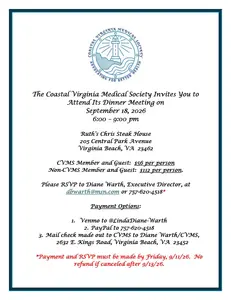
CVMS-Dinner-Meeting-Sep-18-2026
Sep 05, 26 12:29 PM
 Invitation to CVMS-Dinner-Meeting-Sep-18-2026
 -
Safe-Haven-for-healthcare-providers
Sep 05, 26 12:21 PM
Safe-Haven-for-healthcare-providers

Sign Up for the New CVMS Bulletin
Things You Need to Know
News Releases
from the
Virginia Beach Health Department
Norfolk Public Health Department
Chesapeake Health Department

The Roman Fasces was a symbol of strength and power occurring as a result of many binding together. It was made of multiple elm or birchwood rods about 5 feet long tied together and sometimes including an axe. It was carried by attendants to soldiers or powerful figures in ancient Rome. For us, it symbolizes that we are stronger and more powerful if we bind together in supporting our goals.